








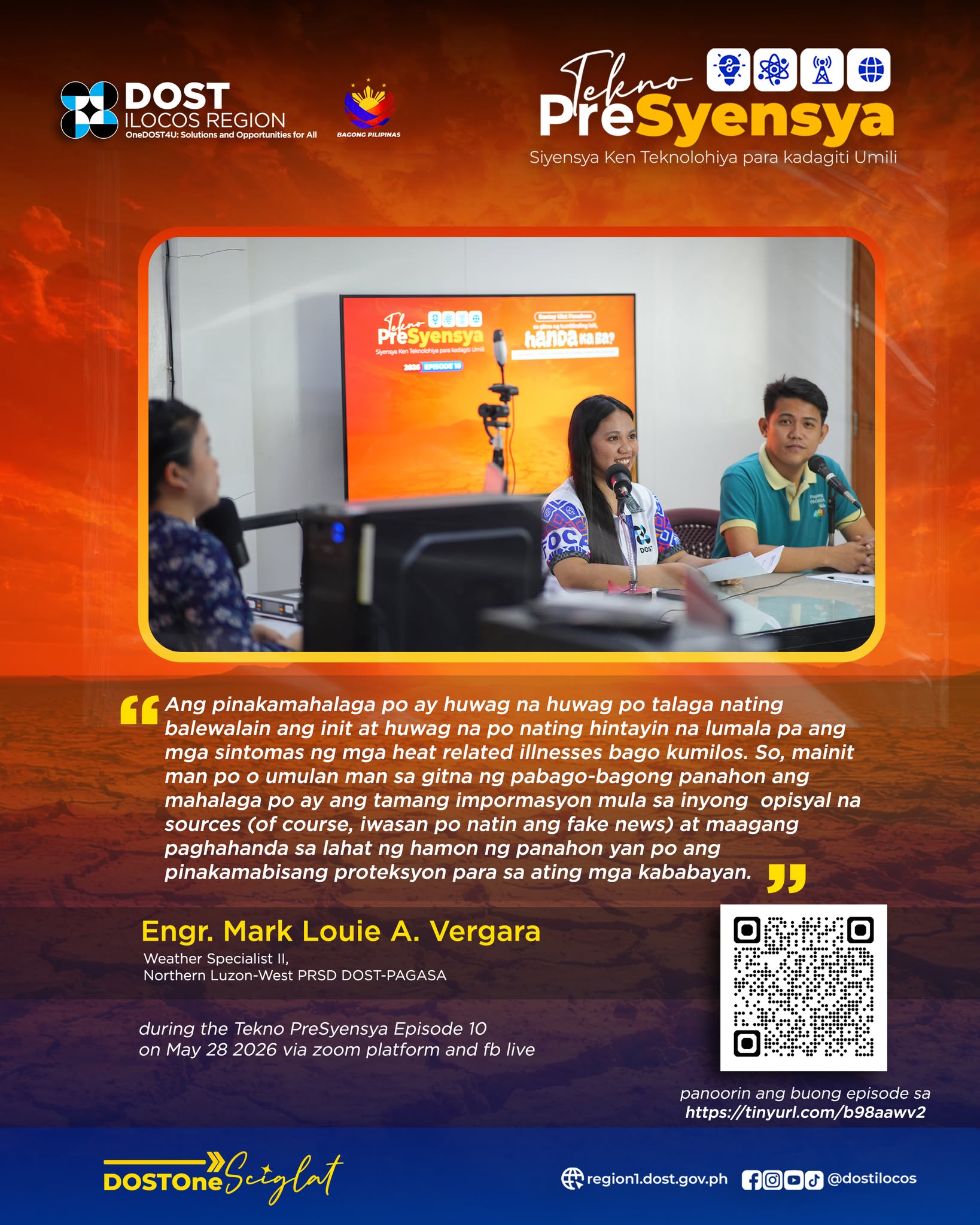
As many areas continue to experience intense morning heat and sudden afternoon rains, the Department of Science and Technology Ilocos Region (DOST Ilocos Region) continues to step up its efforts to provide timely updates about the country’s weather and climate. In response to many questions from the public after Episode 8 of Tekno PreSyensya, the agency hosted a follow-up discussion through Episode 10, titled “Bantay Ulat Panahon: Habagat-El Niño Outlook and Heat Index Monitoring.” The program featured Engr. Mark Louie A. Vergara, Weather Specialist II from DOST-PAGASA Northern Luzon, who cleared up confusion about current weather conditions and what to expect in the coming months.
Engr. Vergara explained that while the country’s weather is currently normal, there is a 79% chance that a strong El Niño will develop between June and August, which could last until the early part of 2027. He corrected a common misunderstanding that the extreme heat we are feeling right now is already caused by El Niño. In fact, the start of El Niño is expected to bring more rain and stronger storms to the western part of the country first. This is because it pulls and strengthens the southwest monsoon (habagat), long before the actual dry weather and water shortage happen toward the end of the year.
The discussion also focused on Tropical Cyclone Jiangmi (locally named Domeng). While the storm is not expected to hit land, it is helping trigger the official start of the rainy season by pulling the habagat winds toward the country. This transition is the reason behind the sudden, heavy afternoon rains currently experienced in parts of the region, which are caused by localized thunderstorms that form after hours of intense morning and midday heat.
The episode also broke down the concept of the heat index, or the “apparent temperature”—which is how hot the weather actually feels to the human body based on the air temperature and relative humidity (the amount of moisture in the air). When humidity is high, the body struggles to sweat and cool itself down, making the air feel heavy and sticky. The agency warned that these conditions can cause severe stress to crop and farm animals and pose serious health risks like heat exhaustion and heat stroke, especially for outdoor workers like farmers, street sweepers, traffic enforcers, and construction workers.
To stay safe at home, Engr. Vergara shared practical tips, advising residents to open windows on opposite sides of the house to create a natural breeze. He warned that running an electric fan inside a closed, unventilated room is unsafe because it only circulates the trapped hot air. The public was strongly urged to check DOST-PAGASA’s official heat index forecasts regularly, and to immediately treat any signs of heat stress with proper rest, continuous hydration, and staying out of direct sunlight.
“Mainit man o maulan sa gitna ng pabago-bagong panahon, ang pinakamahalaga ay ang pagkakaroon ng tamang impormasyon mula sa mga opisyal na mapagkukunan. Iwasan natin ang fake news at ugaliing maging handa sa lahat ng hamon ng panahon—iyan ang isa sa pinakamabisang proteksyon para sa ating mga kababayan,” paggigiit ng ahensya.
Through Tekno PreSyensya, DOST Ilocos Region remains committed to delivering accurate, easy-to-understand weather updates to fight misinformation on digital platforms and keep communities safe through verified reports straight from DOST-PAGASA. (Aryan Joy M. Soliman)